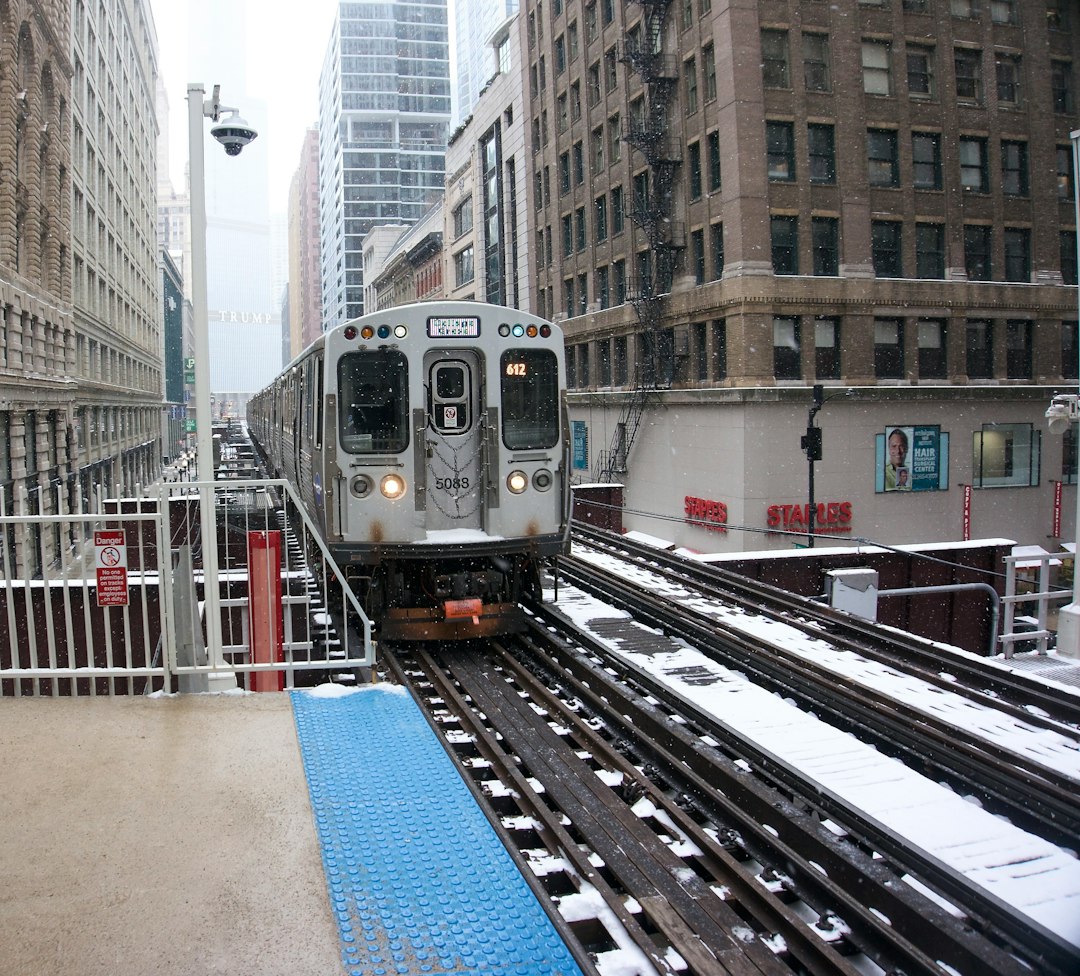
Somebody at your table still calls it “the Ravenswood.” Maybe it’s your uncle. Maybe it’s the guy who’s driven a CTA bus for thirty years. Either way, they’re not wrong. They’re just using the old map.
Chicago’s “L” lines have only been colors since 1993. Before that, every route had a name, usually a hyphenated pileup of the places it connected, and you had to know the system to know which train was yours.
The day the trains got colors
The switch happened on February 21, 1993. According to Chicago-L.org, the CTA dropped its traditional route names that day and gave the six routes colors instead.
The old names didn’t vanish overnight. Chicago-L.org notes they still showed up on the cars’ destination signs, now printed over a background in the line’s new color. A transition period, Chicago style.
The CTA’s own account says the point was to help new or occasional riders, visitors and commuters who speak English as a second language. If the street grid is how you find an address, the colors became how you find the train.
Which old name became which color
Here’s the translation key, per Chicago-L.org:
- Howard-Dan Ryan became the Red Line.
- O’Hare-Congress-Douglas became the Blue Line.
- Lake-Englewood-Jackson Park became the Green Line.
- Ravenswood became the Brown Line.
- Evanston became the Purple Line.
- Skokie Swift became the Yellow Line.
The Blue Line also had earlier aliases. Chicago-L.org says the through-routed service was known at various points as the Milwaukee-Congress-Douglas Line and the West-Northwest Route.
The great reshuffle nobody remembers
Here’s the part that trips people up. The color change came with a rerouting on the very same day.
When the Dan Ryan line opened on September 28, 1969, it was through-routed with the Lake Street “L.” Meanwhile, Howard trains ran through the State Street Subway to Englewood and Jackson Park. So for more than two decades, the north side’s main line was married to a different south side branch than it is now.
On February 21, 1993, the CTA swapped partners. Chicago-L.org explains that Howard was paired with the Dan Ryan to make the Red Line, and Lake was paired with Englewood-Jackson Park to make the Green Line. Linking the two busiest lines meant fewer empty trains at one end and packed trains at the other.
Why these colors and not others
Most of the colors weren’t new. The CTA says red, green and blue had already marked those routes on maps going back to the early 1970s. The Ravenswood was shown as black, then purple, on 1970s maps before settling on brown by the mid-1980s.
Orange used to belong to Skokie. When the Midway line needed a color, it took orange, and the Skokie Swift got yellow. The CTA says yellow was the only popular color left. Streetsblog Chicago adds that yellow is hard to print on maps without a black border, so it went to the shortest route to keep the headaches small.
Streetsblog also reports that Evanston’s line was originally tan on maps, and that purple may nod to Northwestern’s school colors. As for the theory that brown stands for the “wooden” Ravenswood, Streetsblog calls it possibly just an urban legend. The color-coded system map itself was designed by longtime Chicago cartographer Dennis McClendon.
Orange in 1993, Pink in 2006
Orange was the first color without an old name behind it. Per Chicago-L.org, the Midway line opened on October 31, 1993, giving the Southwest Side its first rapid transit link.
Pink came much later. The Pink Line launched June 25, 2006, running over the former Blue Line Cermak (Douglas) branch, then the Paulina Connector and the Lake Street branch into the Loop. The CTA calls it the first new “L” route since the Orange Line.
Its name came from kids. The Chicago Transit Board ran a naming contest for students in kindergarten through eighth grade, who wrote short essays defending a color. Pink, gold and silver were the finalists, and the board picked pink.
The Loop came first
All of this hangs off a structure much older than any color. The Encyclopedia of Chicago says streetcar magnate Charles T. Yerkes, Jr. completed the Union Elevated Railroad in 1897, a downtown loop connecting the city’s elevated lines. Chicago-L.org dates the full Loop operation to October 3, 1897.
Today the Brown, Green, Orange, Pink and Purple Line Express trains use the Loop tracks, per Chicago-L.org. More than a century on, it’s still the hub the whole color wheel spins around.
Why “the Ravenswood” never died
The Ravenswood line is old. Chicago-L.org says service reached Western Avenue on May 18, 1907, and Kimball and Lawrence later that year. It carried that name for more than eight decades before becoming brown.
That’s a lot of muscle memory. Chicago-L.org puts it plainly: the old name lives on with many riders and CTA employees. Same goes for anyone who still says “the Skokie Swift” or “the Evanston.”
These days, people pick neighborhoods by color the way they once picked them by route name. If you’re doing that math, this roundup of apartment buildings near CTA train stations is a useful place to start.
And if you want an old pre-1993 CTA map on your wall, skip the online cart. Neighborhood used bookstores and antique shops turn them up, and you get to hear the shop owner’s own Ravenswood stories for free.
Still calling it by its old name? Tell us which one, and which stop, with #Chicago111.
Sources: CTA, “CTA celebrates 25 years of color coding Chicago’s rail lines”; Chicago-L.org, The CTA Reinvents Itself; Chicago-L.org, North-South Through Routing; Chicago-L.org, West Side Through Routing; Chicago-L.org, Dan Ryan; Chicago-L.org, Ravenswood; Chicago-L.org, Pink Line; Chicago-L.org, Loop; Encyclopedia of Chicago; Streetsblog Chicago.
Photo: Nathyn Masters / Unsplash
Like a place in this story? Go see them in person. One less Amazon order a week.
Leave a Reply