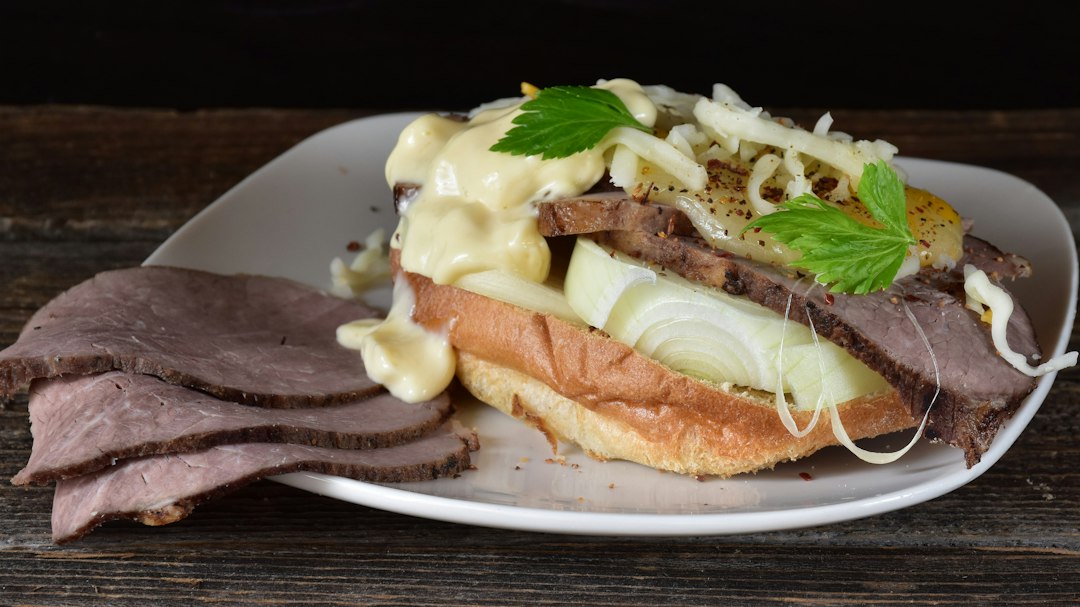
Ordering an Italian beef takes about four seconds if you know the words. If you don’t, the line behind you knows it, and so does the person with the tongs.
So here is the vocabulary, the posture, and the backstory, in roughly the order you’ll need them.
How wet you want it
Every beef order starts with gravy, the seasoned juice the thin-sliced roast sits in. The question is how much of it ends up in your bread.
Dry means the beef gets drained before it goes on the roll. Portillo’s describes it as wringing as much gravy from the beef as possible. The bread stays firm and the sandwich holds together, which is why dry is the pick for eating on the move.
Juicy or wet means the opposite: the meat comes straight out of the pan without draining, sometimes with an extra splash of gravy on top. The bread starts absorbing it immediately and keeps going while you eat.
Dipped is the full commitment. The whole assembled sandwich gets dunked in the gravy, held with tongs, and handed over soaked through. Some people call it baptized. As Tribune food critic Louisa Chu put it to WBEZ, “they call it baptizing your beef.” At Portillo’s you can even order “easy dipped,” a quick one-second dunk for people who want it wet but not structurally compromised.
Hot, sweet, or both
Hot means giardiniera, the pickled vegetable relish in oil. The Chicago version is a chopped mix built around hot peppers, with things like carrots, celery, cauliflower and olives in the jar too.
Sweet means sweet peppers, the roasted or sautéed green and red bell pepper strips. They’re soft, a little smoky, and not sweet in a dessert way.
Hot and sweet gets you both. It is a perfectly normal order, and Portillo’s pitches it as the best of both worlds.
Combo and cheesy
A combo is beef plus an Italian sausage, the sausage tucked into the roll with a pile of beef on top. It is a lot of sandwich. It is also, depending on who you ask, the correct sandwich.
Cheesy adds cheese, usually mozzarella and sometimes provolone. Purists have opinions. The cheese does not care.
Put it together and you get orders like “combo, dipped, hot” or “beef, juicy, hot and sweet.” Beef or combo first, then how wet, then peppers, and you’re done. Same energy as the Chicago dog rules: there’s a canon, and there’s what people actually order.
The Italian stance
A dipped beef is not a sit-down-with-a-napkin-in-your-lap food. Hence the Italian stance, the eating posture Al’s #1 Italian Beef is known for explaining.
As Al’s co-owner Chris Pacelli has described it to Saveur, you plant your elbows on the counter, set your feet back, grip the sandwich with both hands, and bring it up to your face without your elbows ever leaving the counter. In another interview he summed up the logic: stand back about a foot so the juice lands on the floor, not your shirt.
It looks a little like you’re about to be frisked. It works. You’ll see the same lean at every counter in town, done by people who have never heard it called anything.
Where the sandwich came from
The usual story starts with “peanut weddings,” the budget receptions Italian American families held in homes and church basements. The idea, as WTTW tells it, was to stretch a modest amount of beef by slicing it thin and serving it on bread soaked in broth, so a small roast could feed a big crowd.
Al’s tells a specific version. According to the stand’s own history, Anthony Ferreri, a street peddler, saw a beef roast being hand-sliced at one of those weddings, realized he could slice it much thinner on his deli slicer and cook it in its juices, and feed twice as many people. Al’s says Al Ferreri, his sister Frances and her husband Chris Pacelli Sr. opened a family beef stand at Harrison and Laflin in 1938. After urban renewal displaced it, Al’s moved to 1079 W. Taylor St. in the early 1960s, where the flagship still operates.
Other families have claims too. WTTW notes the Ferraro family’s account of selling beef in Little Italy in the mid-1930s, and the Scala name, long tied to supplying the beef itself. A 2024 Chicago Tribune history by Nick Kindelsperger cites “The Chicago Food Encyclopedia” in suggesting the dish probably wasn’t any one person’s invention and instead came out of Italian American home cooking. The earliest printed mention the Tribune found was a 1953 notice for a Villa Scalabrini picnic in Northlake, which promised Italian beef and sausage sandwiches.
Which is to say: nobody can prove who did it first, everybody’s grandfather was involved, and the sandwich is better for it. A certain cable drama later made the rest of the country aware of it. We already knew.
Order it from the stand down the street
This is not a sandwich that survives a delivery box. You live here. Walk to the neighborhood beef stand, say your four words, take the stance, and skip the delivery app. Your money stays on the block, and your lunch stays wet.
Dipped, dry, or somewhere in between? Show us your order and your stance with #Chicago111.
Sources: WBEZ, “Where’s the (best) beef?” with Louisa Chu; Chicago Tribune, “Dip into Chicago’s Italian beef history” (via West Hawaii Today); WTTW, “Who Sold the First Italian Beef?”; Al’s #1 Italian Beef, history; Al’s #1 Italian Beef, about; Saveur, “The Ritual of Italian Beef”; Scripps News, “The Italian beef: a century-old sandwich”; The Takeout, “How to Order an Italian Beef in Chicago”; Portillo’s, “Fifty Shades of Gravy”; Portillo’s, “How to Order”; The Infatuation Chicago, Italian beef guide; Islands, on ordering Italian beef.
Photo: Gennady Zakharin / Unsplash
Like a place in this story? Go see them in person. One less Amazon order a week.
Leave a Reply