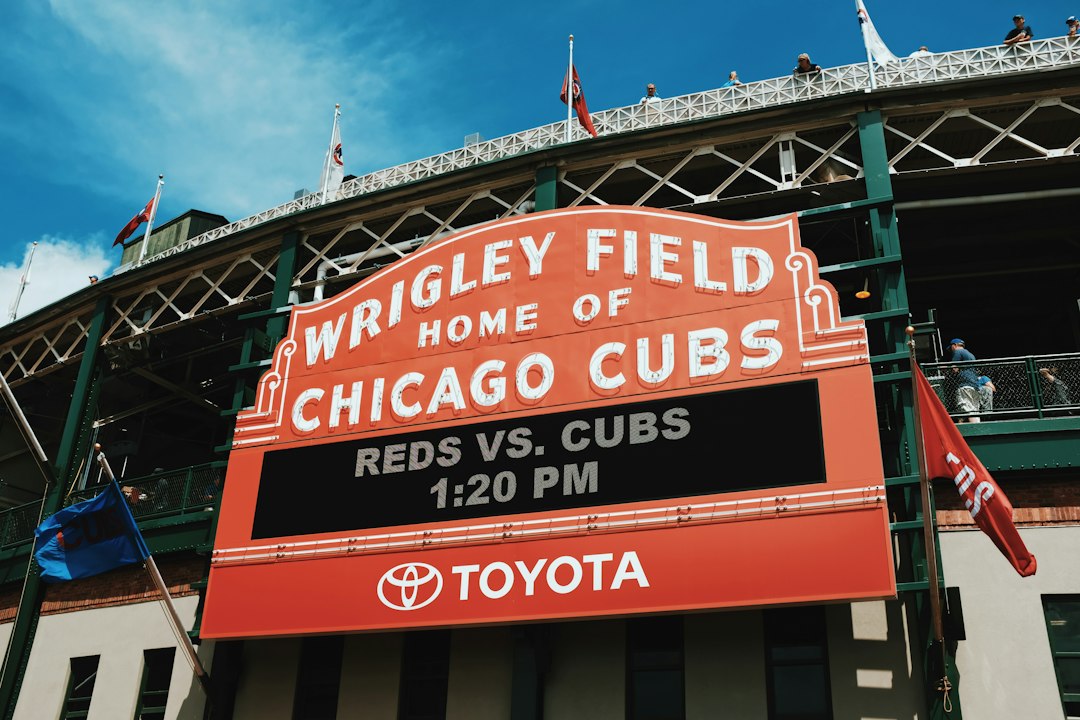
If you live within earshot of Clark and Addison, you already know the two things that make Wrigley Field look like Wrigley Field. One is green and grows. The other is green and gets changed by hand. Both showed up in the same burst of work in 1937, and both have outlasted just about everything else in the neighborhood.
Here is what is actually documented about them, and where the stories people tell at the bar get a little loose.
Who planted the ivy depends on who you ask
The version everyone repeats is that Bill Veeck Jr. planted the vines. The Cubs’ own ballpark history page still says it: the original vines were “purchased and planted by Bill Veeck in September 1937,” with bittersweet strung from the top of the wall and ivy set at the base. The City’s landmark designation report also credits Veeck, though it puts the planting in 1938.
In a 2021 MLB.com fact-versus-fiction piece, Cubs historian Ed Hartig called the Veeck claims “greatly exaggerated.” That story credits the Clavey family, nursery operators who tended Wrigley family properties, with planting it on September 4, 1937, a date backed by a George Brace photograph. Elmer Clavey directed the work with help from his son Gordon. Veeck’s hands-on involvement, per that account, came nearly a month later.
The Baseball Hall of Fame adds groundskeeper Charlie Dorr and his assistant Cotton Bogren to the cast, stringing 5,015 feet of copper wire across the brick, a foot and a half apart, to give the vines something to climb. So the honest answer at the next barbecue: Veeck gets the legend, the Claveys and the grounds crew probably did the digging, and the whole thing happened because Phil Wrigley wanted what the Hall describes as “an outdoor, woodsy motif.”
Boston ivy with a bittersweet head start
The main plant is Boston ivy, which the Hall of Fame describes as a clinging woody vine of the grape family. Because Boston ivy takes its time, it was mixed with Japanese bittersweet to speed things up, according to both MLB.com and the Cubs. The City’s landmark report lists a slightly different mix: Boston and Baltic ivy plus Virginia creeper.
The ground rule for a ball in the vines
The rule is short. As MLB.com put it: “If a fair batted ball lodges in the vines on the bleacher wall, it is a ground-rule double.” Batter and runners each get two bases, and the umpire has no discretion.
That is why you see outfielders throw both arms up instead of digging. Former Cubs outfielder Dexter Fowler explained it in the same story: “If it gets stuck in there, the first thing you do is stick your hands up.”
A scoreboard that still runs on people
The center-field scoreboard went up in 1937 along with the current bleachers, both designed by the Chicago firm Holabird & Root, per the landmark report. It measures 27 by 75 feet. The Interior Department called out the ivy-covered wall, the bleachers and the scoreboard together when it named Wrigley a National Historic Landmark on November 19, 2020. The City had already made it a Chicago Landmark on February 11, 2004.
The Cubs say the score-by-innings and pitchers’ numbers are changed by hand, while the ball, strike and out indicators and the “H” and “E” for hit and error use eyelets. The clock on top arrived in 1941.
Best trivia of the bunch: according to the team, no batted ball has ever hit the scoreboard. Two came close. Bill Nicholson sent one onto Sheffield in 1948, and Roberto Clemente put one onto Waveland in 1959. (If the ballpark’s official address, 1060 W. Addison, has you doing math, here is how the Chicago grid works.)
The W, the L and the flags on the poles
After every game, a flag goes up over the scoreboard. A white flag with a blue W means a win. A blue flag with a white L means a loss. That is the official description from the Cubs. Plenty of neighbors read the result off the mast before checking a phone.
It was not always those colors. NBC Chicago reports that the tradition started with the scoreboard operators in the late 1930s, and that the original W was blue with a white letter. The W flipped to white with blue lettering in the 1980s, once retired-number flags became fixtures on the foul poles. The same story traces the idea to the Wrigley-owned Wilmington Transport company, whose ships ferried fans and players to spring training on Catalina Island and flew a W.
The landmark report adds two quieter details. The center-field flagpole was lengthened to 40 feet in 1969 to hold more team pennants. And in 1978, the blue and white won-lost lights were moved to the cane-shaped poles atop the scoreboard. If you care about flags in general, we have thoughts on the city one too.
A few more for the bleacher regulars
The basket over the outfield wall arrived in 1970, according to the Cubs. The marquee went up in 1934 and was originally fern green with gold trim before turning red in the mid-1960s, per MLB.com. Lights came in 1988, with the first official night game on August 9 of that year.
If you want a W flag of your own for the back porch, skip the cart and pick one up from a shop in the neighborhood. The person behind the counter probably has opinions about the ivy too.
Got a photo of the W going up from your rooftop, porch or the ‘L’ platform? Share it with #Chicago111.
Sources: Chicago Cubs, Wrigley Field History; MLB.com, Fact vs. Fiction: Origin of Wrigley’s ivy; MLB.com, All you need to know about Wrigley Field; MLB.com, Cubs benefit from ball in ivy; City of Chicago, Wrigley Field Landmark Designation Report; City of Chicago, Chicago Landmarks: Wrigley Field; U.S. Department of the Interior; National Baseball Hall of Fame; NBC Chicago.
Photo: Blake Guidry / Unsplash
Like a place in this story? Go see them in person. One less Amazon order a week.

Leave a Reply