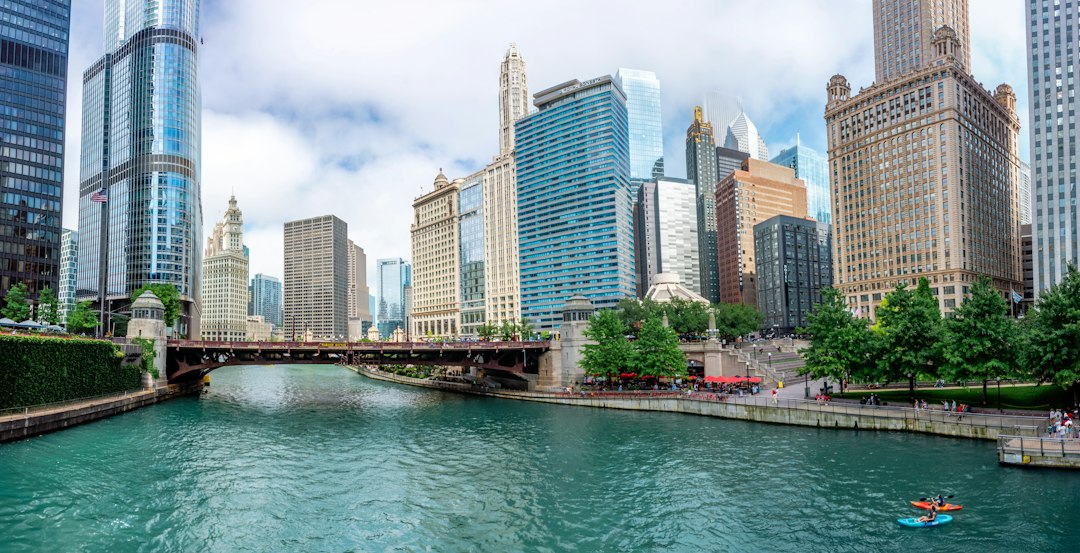
You cross it twice a day. You know its bridges, its tour-boat horns and its faint smell of ambition. What you might not think about on the Riverwalk at 8:40 a.m. is that the water under you is flowing the wrong way, on purpose, and has been since 1900.
The Chicago River used to empty into Lake Michigan, like a normal river. Then Chicago decided that was a problem, and Chicago does not handle problems quietly.
The problem was in the glass
Here was the setup. The river carried the city’s human and industrial waste straight into the lake, and the lake was also where Chicago got its drinking water. That’s the Metropolitan Water Reclamation District’s account, minus the shudder.
Disease was real. WTTW’s Geoffrey Baer notes that cholera waves in 1852 and 1854 together killed at least 1,400 of Chicago’s roughly 30,000 residents.
You may have heard the bigger story, the one where an 1885 storm set off an epidemic that killed 90,000 people. It gets repeated a lot. Per that same WTTW piece: “There is a legend that an 1885 storm caused a wave of cholera that killed 90,000. That never happened.”
A new agency and a very large ditch
On May 29, 1889, the Illinois General Assembly approved the act that created sanitary districts, which is how the Sanitary District of Chicago came to exist. That agency is today’s MWRD. Per its own history page, it was called the Metropolitan Sanitary District of Greater Chicago from 1955 through 1988, and took its current name on January 1, 1989.
The plan: dig a channel that would pull the river away from the lake and send it south toward the Des Plaines River, then the Illinois, then the Mississippi. Digging started on September 3, 1892, with the district’s president, Frank Wenter, turning the first shovel, according to the Encyclopedia of Chicago.
Eight years later the Sanitary and Ship Canal ran 28 miles from the South Branch at Robey Street, now Damen Avenue, to Lockport. (If street renamings and numbers make your head spin, here is our guide to the Chicago grid.) Between 1903 and 1907 the canal was extended to Joliet.
The chief engineer was Isham Randolph, who, MWRD notes, later used the experience to help build the Panama Canal. MWRD also notes that in 1955 the American Society of Civil Engineers named the canal one of the “Seven Wonders of American Engineering,” and ASCE lists the Reversal of the Chicago River among its historic civil engineering landmarks.
January 1900, give or take two weeks
Even the opening date has a little Chicago in it. MWRD says the reversal was officially completed on January 2, 1900. The U.S. Supreme Court, writing a few years later, put it as “The Chicago drainage canal was opened on January 17, 1900.” Either way, that January the river stopped heading for the lake.
St. Louis was not thrilled
Sending sewage downstream works great unless you live downstream. Missouri sued Illinois and the Sanitary District of Chicago, arguing the canal would foul the Mississippi and the water supply near St. Louis. The bill warned of “1,500 tons of poisonous filth daily into the Mississippi.”
On February 19, 1906, the Supreme Court dismissed the case without prejudice in an opinion by Justice Oliver Wendell Holmes, as published by Cornell’s Legal Information Institute. The experts had flatly contradicted each other on whether typhoid could survive the trip of hundreds of miles, and the Court also pointed out that Missouri itself allowed towns to discharge sewage into the Mississippi.
The locks keep the lake and the river apart
A reversed river needs hardware. As part of the project, the district built the Lockport Controlling Works and the Lockport Powerhouse and Lock, near where the canal meets the Des Plaines River, per MWRD.
Downtown, where the river meets the lake, sits the Chicago Harbor Lock. The Sanitary District first built it in 1938, and the U.S. Army Corps of Engineers Chicago District now manages it, according to the Army. It raises and lowers boats between river level and lake level, and tens of thousands of vessels pass through in a season.
Sometimes the river goes back home
Here is the part that surprises people. After an extreme storm, the river is occasionally allowed to flow back into the lake. MWRD is blunt about it: “Reversing to the lake only happens in extreme situations,” and only when the waterways are higher than Lake Michigan. There is, in the agency’s words, “NO MAGIC KEY OR BUTTON to use at will.”
When it happens, gates open on the North Shore Channel in Wilmette and at the locks downtown. During the July 2023 storm, MWRD reported the downtown locks opened at 4 p.m. on July 2 and closed at 2:30 a.m. on July 3. In May 2020, the Army Corps opened the Chicago Lock around 7:30 p.m. on May 17 so the rising river could backflow into the lake, in coordination with MWRD.
These releases typically last less than 24 hours, WTTW reported. MWRD says every effort is made to minimize how much floodwater reaches the lake, and it keeps a list of reversals going back to 1985.
What to do with this on your commute
Next time you’re on the Riverwalk, look at which way the occasional stray coffee lid is drifting. Away from the lake, toward Lockport and eventually the Mississippi.
If this sent you down a rabbit hole, walk to your neighborhood bookstore and ask what they’ve got on Chicago’s rivers. A book handed over by a neighbor beats one more box on the stoop.
Got a favorite spot to watch the river go the “wrong” way, or a photo of the locks mid-lift? Share it with #Chicago111.
Sources: MWRD: History; MWRD: Chicago River’s reversal in 1900 (Sun-Times op-ed); MWRD statement on the July 2023 storm; Encyclopedia of Chicago: Sanitary and Ship Canal construction; Encyclopedia of Chicago: Sanitary and Ship Canal; ASCE: Reversal of the Chicago River; Missouri v. Illinois, 200 U.S. 496 (1906); WTTW: Ask Geoffrey on epidemics; WTTW: Record rainfall prompts reversal into the lake; U.S. Army: Chicago Harbor Lock construction; U.S. Army: USACE Chicago District responds to record rainfall; WBEZ: Drought could lead Chicago River to reverse course again.
Photo: Acool rocket / Unsplash
Like a place in this story? Go see them in person. One less Amazon order a week.
Leave a Reply