Visitors photograph the skyline. Locals live in the two-flat. Walk almost any side street between the lake and the city limits and you’ll pass a row of them: two stories, one apartment per floor, a bay window poking out front, a stoop, a gangway, a back porch with a grill nobody admits to owning.
New York has the brownstone. Philadelphia has the rowhouse. The Chicago Architecture Center calls the two-flat “the real workhorse of Chicago’s built environment,” and anyone who has carried a couch up its front stairs would agree on the work part.
What makes a two-flat a two-flat
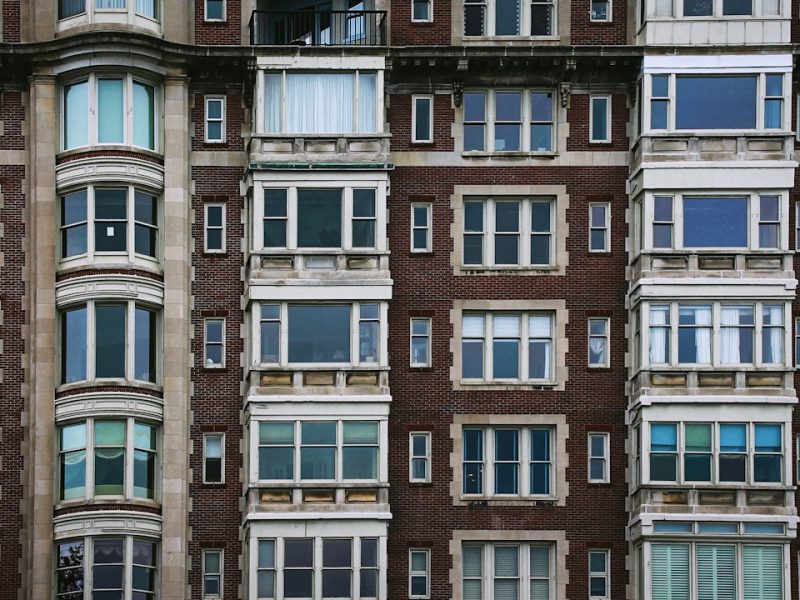
The basic recipe is simple: two units stacked on top of each other, usually on a narrow city lot, usually with a brick or greystone front and a bay window. Garden units, attic bedrooms and the occasional rear coach house are the local improvisations. Most of them went up between 1900 and 1920, according to both the Chicago Architecture Center and WBEZ’s Curious City.
They were built to pay for themselves. WBEZ’s 2014 deep dive traced many West Side two-flats to Czech (Bohemian) immigrant architects and builders working on spec, selling to families, often second-generation immigrants, moving west from Pilsen. Period advertising quoted in that story pitched the building as “a money making proposition”: live downstairs, rent upstairs, let the tenant help with the mortgage. It is still more or less the pitch today.
The boom was real. WBEZ cites a 1910 Chicago Tribune report of $38 million in flat building that year, a record at the time.
The greystone is the dressed-up version
A greystone is less a separate building type than a two-flat (or three-flat, or rowhouse, or mansion) wearing its good coat. The front is faced in pale Bedford limestone quarried in south-central Indiana; the sides and back are usually plain brick, because nobody was paying for limestone the neighbors would only see from the gangway. Look down the side of one sometime. The budget line is right there at the corner.
The Historic Chicago Greystone Initiative’s 2009 design guidelines estimate about 30,000 greystones remain in Chicago, concentrated in a “Greystone Belt” roughly three to seven miles from the Loop. The guide’s list of neighborhoods reads like a CTA map of the North and West sides: Andersonville, Lakeview, Lincoln Park, Logan Square, Wicker Park, Humboldt Park and more. North Lawndale is the stronghold; a 2005 survey for the initiative counted an estimated 1,714 greystones there alone.
The sources don’t quite agree on dates. The 2009 guidelines say greystones were popular between 1890 and 1930; the 2005 survey, as summarized by writer David B. Williams, puts most of them between 1890 and 1915. Either way, your greystone is probably older than your grandmother.
How to read the front of one
The survey Williams describes splits greystones into two looks. The earlier ones are Romanesque: rough-faced, rusticated stone, heavy arches, a cornice up top. The later ones go classical: smooth stone, bay windows, Palladian windows, columns. If your building looks like it could hold off a siege, it’s probably the early kind. If it looks like it wants to sell you life insurance, it’s the later kind.
Other things worth noticing on your next walk: the carved address or date stone, the pressed-metal cornice on the brick versions, and the little window in the gable that someone has definitely turned into an office.
There are more of them than you think, and fewer every year
Small apartment buildings are a huge share of how this city is housed. The Chicago Architecture Center says two-flats, along with four-flats and six-flats, make up more than 30 percent of the city’s housing stock. DePaul University’s Institute for Housing Studies, counting a little differently, found in 2021 that buildings with two to four units hold 26 percent of all residential units and over 35 percent of the city’s rental housing. Back in 2014, WBEZ counted more than 76,000 two-unit buildings and reported that in Brighton Park, New City and South Lawndale, two-flats made up more than two-thirds of the housing stock.
That same DePaul research found Chicago lost roughly 6 percent of its 2-to-4-unit rental stock between 2012 and 2019, with the steepest losses in higher-cost neighborhoods on the North and Northwest sides, where two-flats are being converted into single-family homes. One building, one fewer apartment, one more very large kitchen.
It matters for renters in particular: the institute found roughly 60 percent of Latino-headed renter households and 32 percent of Black-headed renter households live in 2-to-4-unit buildings.
Living in one
Two-flat life comes with its own rules. You know your upstairs neighbor’s walking schedule. The landlord may live downstairs and also be the person who shovels. The basement is shared, damp and full of someone’s bike from 2011. Laundry is a coin machine or a negotiation.
If you’re weighing a move into the Greystone Belt, browsing apartment buildings in Lakeview is a decent way to compare the vintage stock against the newer towers before you start touring. And if you’re new enough to still be sorting out which side of which street counts as which neighborhood, our guide to community areas and neighborhood border wars will help, as will a quick refresher on Chicago address math.
One more thing: the two-flat block usually has a corner store, a hardware shop or a tavern within a few hundred feet, because these neighborhoods were built for walking. Next time you need a furnace filter or a gallon of paint, walk it. The building next door was paid for by people doing the same.
Live in a two-flat or a greystone with a good story, a great cornice or a basement you’re scared of? Show us with #Chicago111.
Sources: Chicago Architecture Center; WBEZ Curious City (2014); Historic Chicago Greystone Initiative design guidelines (2009, via Landmarks Illinois); David B. Williams, Greystones: Chicago’s Answer to Brownstones; DePaul Institute for Housing Studies findings (2021, via Preservation Chicago).
Photo: Bo Zhang / Unsplash
Like a place in this story? Go see them in person. One less Amazon order a week.
Leave a Reply